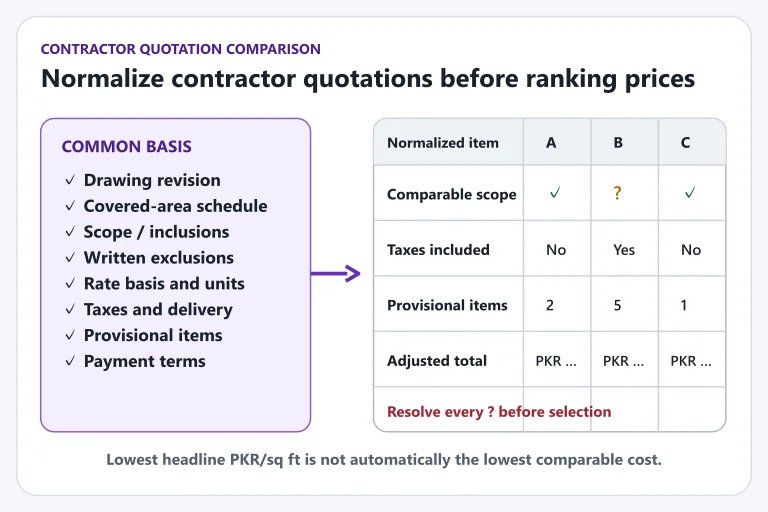
Do not rank quotations until every bidder has the same area schedule, drawings, specification and inclusion list. Compare normalized cost, payment risk and unresolved scope—not headline PKR per square foot alone.

Build a comparison sheet before reading totals
| Heading | Questions to resolve |
|---|---|
| Document basis | Which drawing revision, specification and area schedule were priced? |
| Scope | Are excavation, foundations, RCC, masonry, waterproofing, sleeves, boundary walls and external works included? |
| Materials | Who supplies cement, steel, bricks, sand, aggregate, water, formwork and testing? |
| Commercial terms | Are taxes, transport, pumping, machinery, supervision and overhead included? |
| Price adjustment | Is the rate fixed, time-limited or subject to an escalation formula? |
| Measurement and payment | Are payments based on area, BOQ quantities, milestones or actual measured work? |
| Provisional items | Which amounts can change after award? |
| Time and responsibility | What are start, duration, extension, delay and defect obligations? |
PEC's standard documents emphasize project-specific tender data, drawings, specifications, schedules and bills of quantities. A small residential job may use a simpler contract, but the same logic is useful: describe the work well enough that prices are comparable.

A normalized comparison example
Bid A offers PKR 3,300/sq ft for 3,000 sq ft, apparently PKR 9.9 million. Bid B offers PKR 3,450/sq ft, apparently PKR 10.35 million. If Bid A excludes PKR 350,000 of pumping, testing and waterproofing included by Bid B, its normalized comparison becomes PKR 10.25 million. The difference is then PKR 100,000, not PKR 450,000.
Comparable total = quoted total + missing agreed scope − included items outside the comparison scope + adjustment to a common provisional allowance
Only adjust an item when its scope and value can be supported. If Bid A's waterproofing exclusion has no price, enter “unpriced” rather than zero. An incomplete bid should remain visibly incomplete until the bidder supplies the missing figure.
Keep quoted facts separate from your adjustments
| Line | Bid A | Bid B |
|---|---|---|
| Quoted total | PKR 9,900,000 | PKR 10,350,000 |
| Priced missing scope | PKR 350,000 | Included |
| Comparable total | PKR 10,250,000 | PKR 10,350,000 |
| Comparable rate over 3,000 sq ft | PKR 3,416.67/sq ft | PKR 3,450/sq ft |
The PKR 350,000 adjustment is an illustrative assumed price, not a market quotation. In a real comparison, attach its source and ask the bidder to confirm responsibility for that work. Your worksheet calculation does not amend the contractor's offer by itself.
Read the payment schedule beside the scope
Two equal totals can require very different amounts of cash before useful work is complete. List the advance, each milestone amount, evidence required for payment and any remaining balance. Confirm that the milestone amounts add back to the quoted total. If a milestone says “roof complete,” clarify whether it means reinforcement fixed, concrete placed or the agreed completion and records for that stage.
Keep provisional sums visible too. If a quoted PKR 200,000 allowance is replaced by a common PKR 300,000 comparison allowance, add only PKR 100,000 to that bid. Adding PKR 300,000 again would double-count the amount already included.
Questions that expose hidden scope
- What exactly completes the “grey structure” milestone?
- Are foundations based on current structural drawings or an allowance?
- Who pays for changes caused by revised drawings or soil conditions?
- Are formwork, scaffolding, curing water, power, security and debris removal included?
- How are material brands or grades approved and substituted?
- What evidence supports each payment claim?
- What happens to unused owner-supplied material and recoverable steel offcuts?
Price is only one selection dimension
Review references you can verify, current workload, proposed supervision, programme realism, safety practice, quality records and willingness to document changes. Do not publish or rely on fabricated testimonials. Speak to prior clients directly and inspect completed or active work with permission.
Contract note
This guide is a comparison framework, not legal advice or a residential contract template. Have the final scope and contract reviewed for the project's value, risks and jurisdiction.
Questions people ask
Is the lowest per-square-foot rate the cheapest quotation?
Not necessarily. The rate may use a different covered area, exclude materials or services, shift price risk, or leave major items provisional.
What is a provisional sum?
It is an allowance for work or cost that is not fully defined at tender stage. Compare it separately because the final amount may change.
Should labour-only and material-inclusive bids be compared together?
Only after converting them to a common scope and adding the owner's separately purchased materials, logistics, testing, taxes and risk.
Sources and verification
- Pakistan Engineering Council — Bidding Documents ImplementationOfficial context for project-specific tender data, schedules, specifications, drawings and bills of quantities.
- Pakistan Engineering Council — Standard bidding document for civil worksContract-document context for rates, risks, contingencies and Bill of Quantities pricing.
- Pakistan Engineering Council — Building Code of Pakistan 2021National building-code context for safety, administration, structural work and the authority having jurisdiction.
Sources establish the technical context. Calculator planning assumptions remain separately labelled and should be checked for the specific project.