Use official price series to understand direction, then obtain comparable local quotations for the actual specification and delivery point. Build a dated rate from quantities and commercial scope; do not copy a social-media rate into a project budget without evidence.
Use three layers of evidence
- Official direction: PBS monthly urban and rural construction-item tables indicate how selected inputs move across reported markets.
- Local quotations: suppliers and labour teams price the actual grade, quantity, location, delivery and timing.
- Project build-up: drawings, quantities, waste, plant, supervision, tax, overhead and contract risk turn inputs into an all-in rate.
PBS publishes cement, bricks, iron bars and other construction-related observations in its price statistics. The series is valuable evidence, but it is not a tender and does not certify the quality or availability of a specific product.

Normalize supplier evidence
| Field | Why |
|---|---|
| Date and validity | Prevents an expired quotation being treated as current. |
| Product and specification | Makes grade, standard, brand and size comparable. |
| Unit and quantity | Separates per-bag, per-tonne, per-thousand and truck-based prices. |
| Delivery point | Captures transport, access and unloading differences. |
| Tax treatment | Avoids comparing inclusive and exclusive prices. |
| Payment terms | Cash, credit, advance and retention can affect price and risk. |

Update the rate without hiding the old basis
Retain the prior estimate, then create a new version. Replace item rates where evidence exists, record design or quantity changes separately, and explain any contingency change. This shows whether the budget moved because the market changed or because the project changed.
Updated priced work = sum of current item rate × corresponding quantity
Updated project total = priced work + separately excluded project costs + stated contingency
Check what each item rate already contains before adding labour, plant, tax or overhead. An installed-work rate may include several of these; adding them again would inflate the estimate. A materials-only build-up needs a different set of additions.
A small worked example
If cement represents PKR 1.50 million of an old direct-cost build-up and comparable current evidence is 8% higher, the cement component changes by PKR 120,000. Do not increase the entire project by 8% unless the evidence supports the same movement for every component.
Convert quotation units before selecting a supplier
Consider an illustrative steel quotation of PKR 250,000 per metric tonne, with PKR 12,000 transport for an order of 3 tonnes. Its delivered pre-tax rate is (750,000 + 12,000) ÷ 3,000 = PKR 254/kg. A second quote of PKR 252/kg including delivery would be lower on that basis, provided the grade, accepted quantity, tax treatment, payment terms and delivery conditions match. These numbers demonstrate normalization; they are not current steel prices.
Do not convert a truck or trolley price to cubic feet using an assumed load size. Obtain the agreed measured capacity or delivery quantity first. For cement, record bag mass with the per-bag price; for bricks, record the accepted unit count and specification with the per-thousand quote.
Explain a budget increase in two parts
If both quantity and rate changed, preserve them separately. Suppose 1,000 bags at an illustrative PKR 1,300 became 1,100 bags at PKR 1,400. The total rises from PKR 1,300,000 to PKR 1,540,000. Using the old quantity as the price-change basis, PKR 100,000 comes from the higher rate and PKR 140,000 from the extra 100 bags priced at the new rate. Together they explain the PKR 240,000 change.
This split lets an owner see whether a revised layout, a corrected take-off or market movement drove the change. It also avoids calling every increase “inflation.”
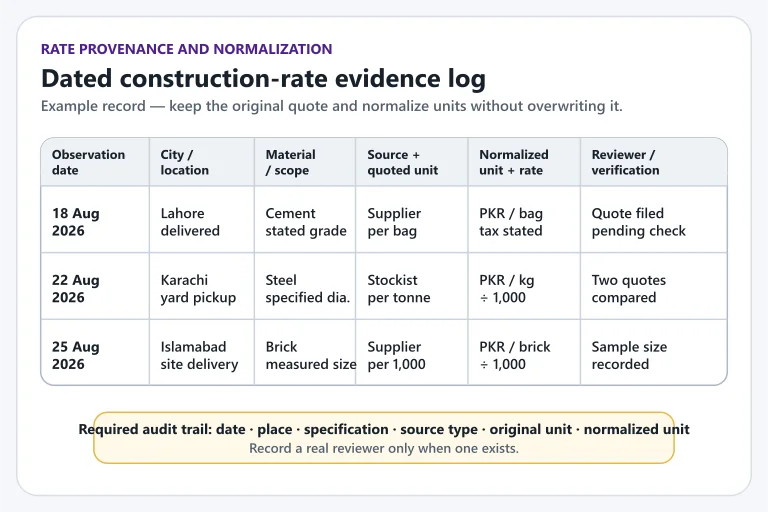
Maintain a rate-change log
- Estimate version and date.
- Source document or quotation reference.
- Old rate, new rate and unit.
- Quantity affected.
- Reason: market movement, specification change, design revision or scope correction.
- Reviewer and unresolved uncertainty.
Calculator use
When you have a current all-in grey-structure rate, enable the custom-rate option on the main calculator. It uses that rate directly and does not add city or storey cost multipliers again.
Questions people ask
Can PBS construction prices be used as a contractor rate?
No. PBS tables help track item-price direction. An all-in project rate also reflects specification, quantities, delivery, labour, plant, overhead, tax, risk and contract terms.
How many supplier quotations should I obtain?
There is no universal number, but multiple comparable, dated quotations help reveal outliers. Record the same grade, unit, quantity, delivery point and tax treatment for each.
How often should a planning rate be updated?
Update it when the estimate is used for a decision, after a material design or scope change, and when dated market evidence has moved enough to affect the contingency or funding plan.
Sources and verification
- Pakistan Bureau of Statistics — Price StatisticsMonthly urban and rural construction-item price tables and national price-index publications.
- Pakistan Engineering Council — Bidding Documents ImplementationOfficial context for project-specific tender data, schedules, specifications, drawings and bills of quantities.
- Pakistan Engineering Council — Standard bidding document for civil worksContract-document context for rates, risks, contingencies and Bill of Quantities pricing.
- Pakistan Standards and Quality Control Authority — Civil standards catalogueOfficial catalogue covering civil materials, including cement and reinforcement standards.
Sources establish the technical context. Calculator planning assumptions remain separately labelled and should be checked for the specific project.