Material calculator
Concrete & cement calculator
Estimate concrete volume, cement bags, sand and crush for a rectangular slab or pour using transparent nominal-mix assumptions.
Calculation results
Formula and assumptions
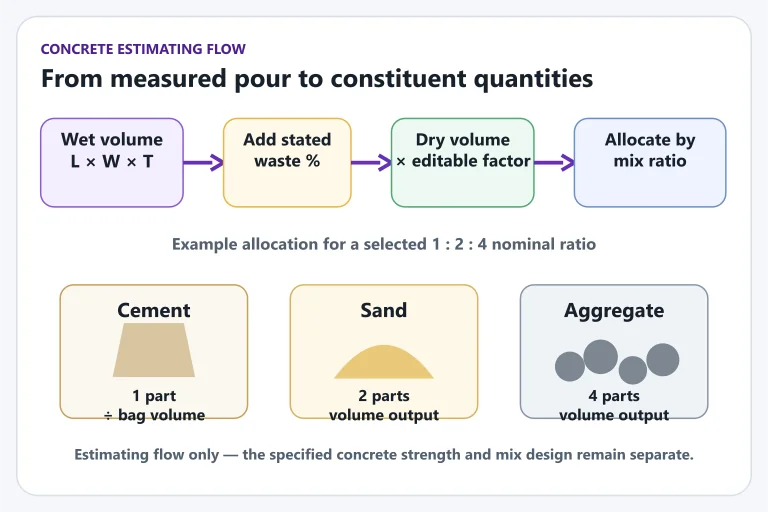
The calculator finds rectangular wet volume, adds waste, multiplies by the editable dry-volume factor, then divides dry volume according to the selected cement:sand:aggregate ratio.
Wet cft = length in ft × width in ft × thickness in inches ÷ 12
Wet cft with allowance = wet cft × (1 + waste percentage ÷ 100)
Dry cft = wet cft with allowance × dry factor
Cement bags = cement share of dry cft ÷ 1.25
Nominal proportions are estimating aids. They do not replace a designed concrete mix, batching controls, cube tests or structural specifications.
Worked example
A 20 ft × 15 ft slab at 6 inches thick has 150 cft of wet concrete before waste and 157.5 cft after 5% waste. Applying the 1.54 dry-volume factor gives 242.55 cft. For a 1:2:4 mix, that is about 27.7 cement bags (at 1.25 cft per bag), 69.3 cft sand and 138.6 cft crush.
Which result should you use?
| Result | Example | Meaning |
|---|---|---|
| Wet volume before waste | 150 cft | Geometry of the entered rectangular pour. |
| Wet volume including allowance | 157.5 cft / 4.460 m³ | Geometry plus the selected 5% allowance; a starting point for a ready-mix quantity enquiry. |
| Dry material volume | 242.55 cft | Intermediate loose-material planning volume, not the finished concrete order. |
| Cement, sand and crush | 27.7 bags / 69.3 cft / 138.6 cft | Allocation under the selected nominal ratio and bag-volume assumption. |
Changing the nominal ratio changes the constituent allocation but does not change the wet concrete volume. The tool does not calculate mixing water or prescribe a water-cement ratio. The displayed bag count is a calculated quantity; any whole-bag purchase rounding and existing usable stock belong in a separate order calculation.

Measure the pour before estimating materials
Break an irregular pour into simple shapes and calculate each part separately. For a beam-and-slab system, measure slab panels, beams, columns and upstands from the approved drawings instead of multiplying the overall roof footprint by one thickness. Deduct only voids that are genuinely absent from the pour.
Enter feet for length and width but inches for thickness. Six inches means 6 in the thickness field, not 0.5. For a dimension of 10 ft 6 in, use 10.5 in a feet field. The form calculates one solid rectangle at a time and has no automatic opening or beam deduction.
- Use the same drawing revision for length, width and thickness.
- Keep cubic feet and cubic metres visible in the take-off so unit conversion can be checked.
- Record whether waste covers spillage only or also overbreak, uneven formwork and rejected material.
- Do not convert a nominal 1:2:4 result into a structural specification. Strength, workability, durability, aggregate moisture and trial batches belong to mix design and quality control.
Why the dry-volume factor is only an estimating convention
Loose ingredients do not translate to finished concrete through one universal multiplier. Aggregate grading, voids, moisture, compaction and batching method affect yield. ACI proportioning guidance uses absolute volumes and trial-batch adjustment, which is more rigorous than a fixed dry factor. This calculator keeps the factor editable because its purpose is early material planning, not mix approval.
Before saving the result
Check that the dimensions refer to the same drawing revision, note which member the calculation describes, and record why the selected allowance is appropriate. Recalculate after changing any input, then copy, print or download the current result. For several members, retain one result per member and sum the same output column; do not add dry-material volume to wet volume.
Frequently asked questions
What does the dry-volume factor mean?
Dry ingredients occupy more loose volume than finished compacted concrete. The calculator defaults to 1.54 and lets you edit it for your estimating method.
How many cubic feet are assumed in one cement bag?
The calculator uses 1.25 cubic feet per bag as a planning conversion and shows this assumption beside the result.
Can this choose a structural concrete mix for me?
No. It only estimates materials for the mix you select. A qualified engineer must specify concrete strength and mix requirements.
Sources and verification
- American Concrete Institute — ACI PRC-211.1-22Concrete proportioning guidance based on absolute volume, workability, strength, durability and trial-batch adjustment.
- PSQCA PS 232-2015 — Ordinary Portland CementPakistan specification for Ordinary Portland Cement; use the applicable project specification and current standard edition.
- Pakistan Engineering Council — Building Code of Pakistan 2021National building-code context for safety, administration, structural work and the authority having jurisdiction.
Sources establish the technical context. Calculator planning assumptions remain separately labelled and should be checked for the specific project.
Need a project-wide planning estimate? Use the grey structure cost calculator. For reinforcement, use the steel / saria calculator.